Bookkeeper vs Accountant Comparison to Help You Make the Right Choice
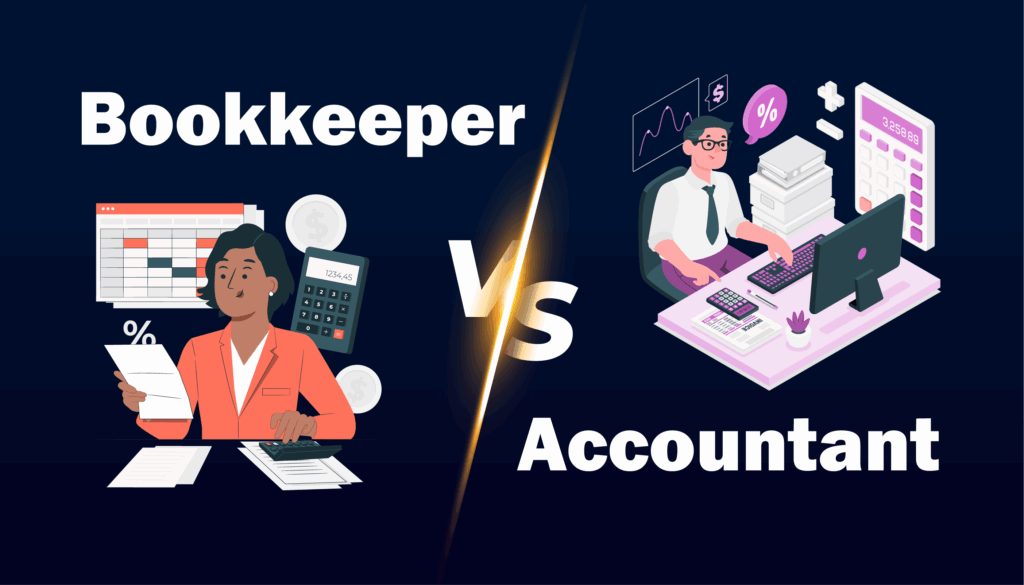
When it comes to managing your business finances, choosing the right professional can make all the difference. Whether you’re a new entrepreneur or an established business owner, understanding the key differences between a bookkeeper and an accountant can save you time, money, and stress.
At One Accounting, we specialise in providing comprehensive bookkeeping and accounting services to businesses in Toronto and beyond, all under one roof. This guide breaks down the bookkeeper vs accountant debate to help you make the right decision for your financial needs.
Let’s begin by outlining the core functions that differentiate bookkeepers from accountants.
Defining the Roles: Bookkeeper and Accountant
Bookkeeper
A bookkeeper is primarily responsible for recording day-to-day financial transactions. Their job includes tracking income, expenses, receipts, and payments to ensure accurate and up-to-date financial records.
Bookkeepers also manage accounts payable and receivable, making sure that invoices are sent on time and bills are paid. They provide the foundational financial data that businesses need to operate smoothly.
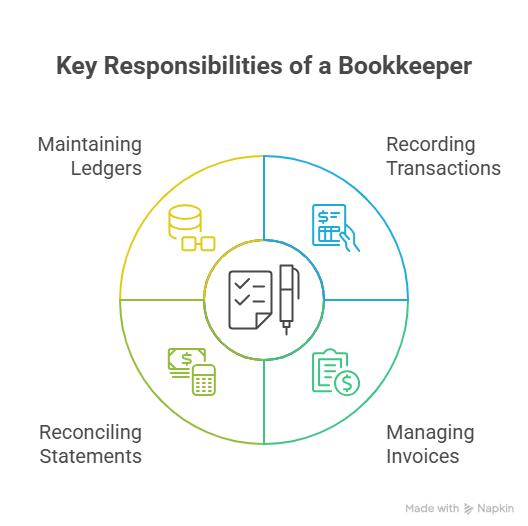
A bookkeeper’s main tasks typically include the following:
- Records daily financial transactions such as sales and expenses.
- Manages invoicing and bill payments.
- Reconciles bank statements and monitors cash flow.
- Maintains general ledgers and financial records.
Accountant
On the other hand, an accountant takes the information compiled by the bookkeeper and interprets it to provide valuable insights. Accountants prepare tax documents, analyze financial statements, and offer strategic planning to help businesses grow.
Their work ensures that companies are compliant with financial regulations and are making informed decisions. While bookkeepers focus on the present, accountants plan for the future.
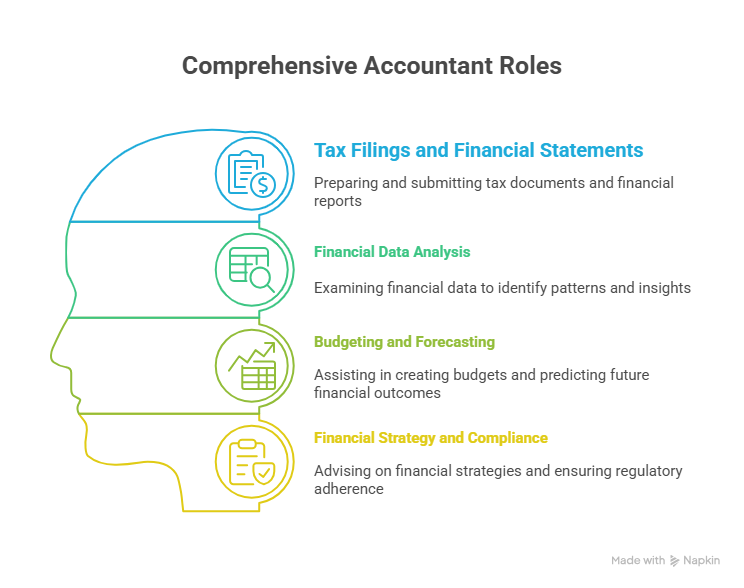
When working with an accountant, you’ll encounter duties like those listed as follows:
- Prepares tax filings and financial statements.
- Analyzes financial data and identifies trends.
- Provides budgeting and forecasting support.
- Advises on financial strategy and regulatory compliance.
Once the roles are clear, it’s time to explore the qualifications required for each. The skills and credentials of each role can further clarify who you need for your business.
Educational Background and Certifications
Bookkeeper
They often continue their education by staying current with the latest bookkeeping software and industry standards. Practical experience is also highly valued in this role.
- May have a college diploma or bookkeeping certificate.
- Can become a Certified Professional Bookkeeper (CPB).
- Gains expertise through hands-on experience.
- Often specializes in bookkeeping software and tools.
Accountant
Accountants typically hold a university degree in accounting or finance and may pursue professional designations such as CPA (Chartered Professional Accountant). Their training is more extensive, covering topics like tax law, auditing, and financial analysis.
They are required to complete ongoing education to maintain their certification and keep up with changes in regulations. This level of expertise prepares them for more complex financial tasks.
- Holds a degree in accounting, finance, or related field.
- May have CPA or other professional certifications.
- Trained in regulatory compliance, auditing, and taxation.
- Must engage in continuing education and development.
Let’s dive into the actual tasks each role performs to keep your finances in check.
Daily Responsibilities and Tasks
Bookkeeper
The daily duties of a bookkeeper revolve around maintaining financial records. This includes recording transactions, managing payroll, handling invoices, and reconciling bank statements.
Bookkeepers ensure that all financial activity is properly documented and categorized. Their consistent and detailed work provides an accurate picture of the business’s current financial status.
A bookkeeper’s routine tasks typically look like the following:
- Handles day-to-day bookkeeping tasks.
- Tracks payments, expenses, and receipts.
- Manages invoicing and payroll.
- Reconciles financial accounts monthly.
Accountant
Accountants focus on higher-level financial activities that require analysis and interpretation. They prepare detailed reports, file taxes, and help businesses develop budgets and forecasts. Accountants also conduct audits to ensure compliance and identify areas for financial improvement. Their work supports long-term financial planning and decision-making.
- Generates monthly and annual financial statements.
- Develops tax strategies and files returns.
- Assists in creating budgets and business forecasts.
- Evaluate financial performance and advise on improvements.
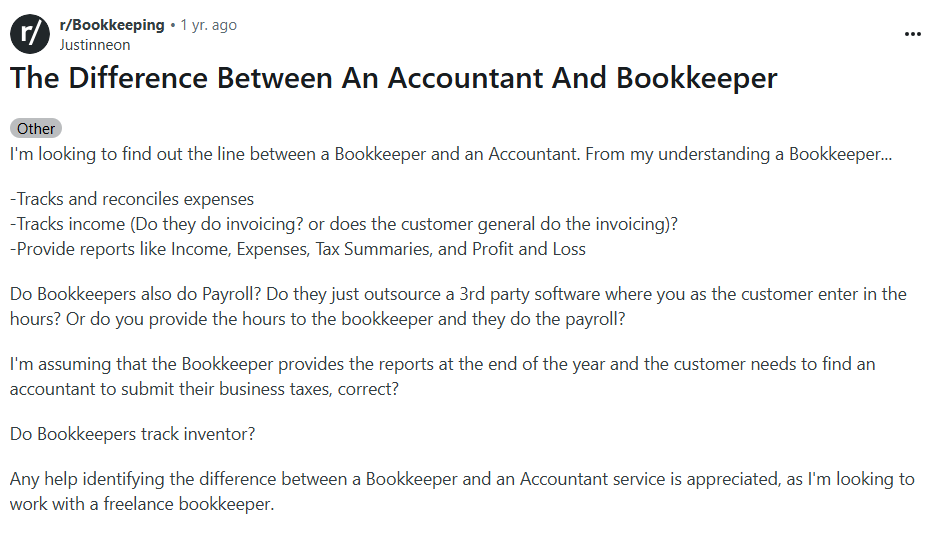
To dive deeper into real-world perspectives, here’s a Reddit discussion where users share their views on the key differences between an accountant and a bookkeeper.
Both professionals rely on technology, but the tools they use differ significantly. To better understand their efficiency, it’s useful to look at the tools they depend on.
Tools and Technologies Used
Bookkeeper
Bookkeepers rely on user-friendly software like QuickBooks, FreshBooks, and Xero to manage everyday financial tasks. These tools allow them to automate invoicing, track expenses, and reconcile accounts efficiently.
Bookkeepers often work in cloud-based environments, making it easy to access and update records in real time. Their tools are designed to streamline repetitive tasks and reduce errors.
Bookkeepers commonly work with technologies like those listed as follows:
- Uses QuickBooks, Xero, and FreshBooks.
- Automates billing, payroll, and categorization.
- Works on cloud-based platforms for real-time updates.
- Generates basic financial summaries and ledgers.
Accountant
Accountants, in contrast, use more advanced software tools suited for analysis and reporting. Programs like Sage, and Excel with advanced functions, and tax platforms like ProFile help them create financial models and handle complex calculations.
Accountants integrate data from bookkeeping systems to produce strategic insights and financial reports. Their tools support decision-making and compliance with regulatory standards.
You’ll find that accountants frequently depend on tools like those outlined below:
- Uses advanced tools like Excel, Sage, and ProFile.
- Analyzes data for audits and financial planning.
- Prepares detailed tax filings and financial models.
- Integrates multiple software platforms for data analysis.
With their tasks and tools understood, let’s now examine the financial aspect of hiring each.
Cost Implications
Bookkeeper
Hiring a bookkeeper is generally more affordable than hiring an accountant. Because their tasks are more administrative and less complex, bookkeepers charge lower hourly or monthly rates. They are a cost-effective solution for businesses that need support with routine financial tasks. Bookkeepers provide great value by freeing up business owners’ time.
- Charges lower fees due to routine tasks.
- Offers flexible pricing models (hourly or monthly).
- Provides cost-effective solutions for small businesses.
- Helps reduce business owners’ workload.
Accountant
Accountants come at a higher price point due to their specialized knowledge and strategic role. Their expertise in tax planning, compliance, and financial forecasting justifies the investment.
Businesses often find that the insights and savings provided by accountants outweigh their costs. The choice between bookkeeper vs accountant should consider both your current budget and long-term financial goals.
You can evaluate the cost-benefit of accountants through the elements detailed below:
- Charges premium rates for strategic services.
- Offers higher value through financial planning and tax advice.
- Justifies cost with long-term financial savings.
- Typically hired for high-impact decisions and compliance.
Understanding the right moment to engage a bookkeeper can save you from operational stress. So, when exactly should a business consider hiring a bookkeeper?
When to Hire a Bookkeeper
You should consider hiring a bookkeeper when your daily financial tasks become overwhelming. If you find it difficult to track income and expenses, manage payroll, or reconcile accounts, a bookkeeper can provide much-needed relief. Their services help keep your financial records organized and up-to-date. This allows you to focus more on running your business.
You may want to consider hiring a bookkeeper under circumstances like the following:
- Ideal when overwhelmed with daily financial tasks.
- Needed for organizing receipts and tracking expenses.
- Supports accurate payroll and invoice management.
- Helps prepare books for tax season.
Bookkeepers are especially useful for small businesses and startups. They ensure that all transactions are properly recorded and that your books are ready for review by an accountant when needed. Having a bookkeeper also prepares you for tax season with clean and organized records. Their presence brings consistency and reliability to your financial operations.
If you’re planning for the future, it may be time to consider the value of an accountant.
When to Hire an Accountant
Their insights help you make informed decisions and stay compliant with financial regulations. Accountants provide valuable support for both day-to-day decisions and long-term planning.
The need for strategic financial guidance often arises in situations like the following:
- Essential for year-end reporting and taxes.
- Helps with budgeting, funding, and strategic growth.
- Supports compliance with financial laws.
- Provides expert financial insights.
Accountants also help you optimize your tax strategy and identify opportunities for financial growth. They analyze trends and create projections that help shape your business strategy.
While each role has its strengths, their combined impact can be even more powerful. Let’s see how bookkeepers and accountants work together to create a seamless financial workflow.
The Synergy of Both Roles
Bookkeeper
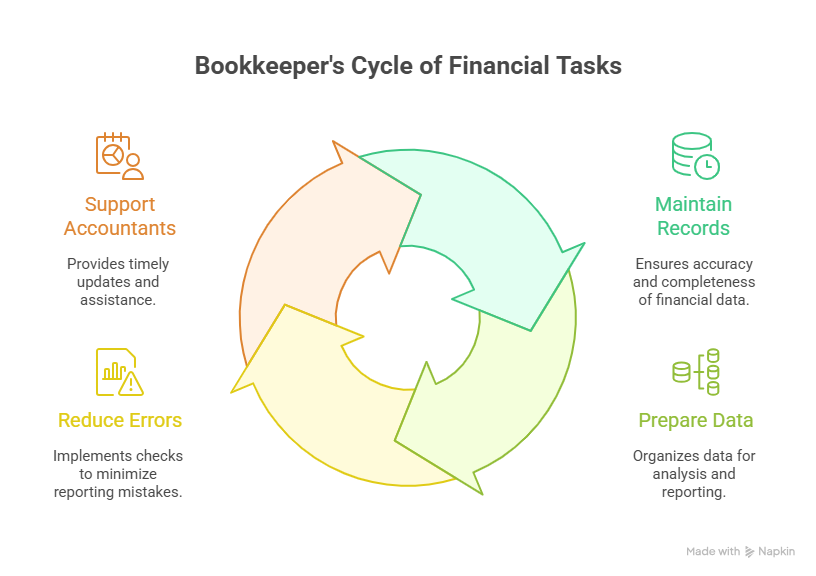
Many businesses benefit from the combined efforts of both a bookkeeper and an accountant. The bookkeeper ensures that financial records are accurate, timely, and complete. They maintain the books in a way that makes it easier for accountants to perform their tasks. This collaboration minimizes errors and improves efficiency.
In a dual-role setup, the bookkeeper contributes to tasks like the ones shown as follows:
- Maintains accurate financial records.
- Prepares financial data for analysis.
- Reduces the risk of errors in reports.
- Supports accountants with real-time updates.
Accountant
The accountant takes the bookkeeper’s data and uses it to generate reports, file taxes, and develop strategic plans. By working together, they cover all aspects of financial management. This teamwork allows for real-time monitoring and long-term forecasting. Employing both roles ensures that your business remains financially healthy and compliant.
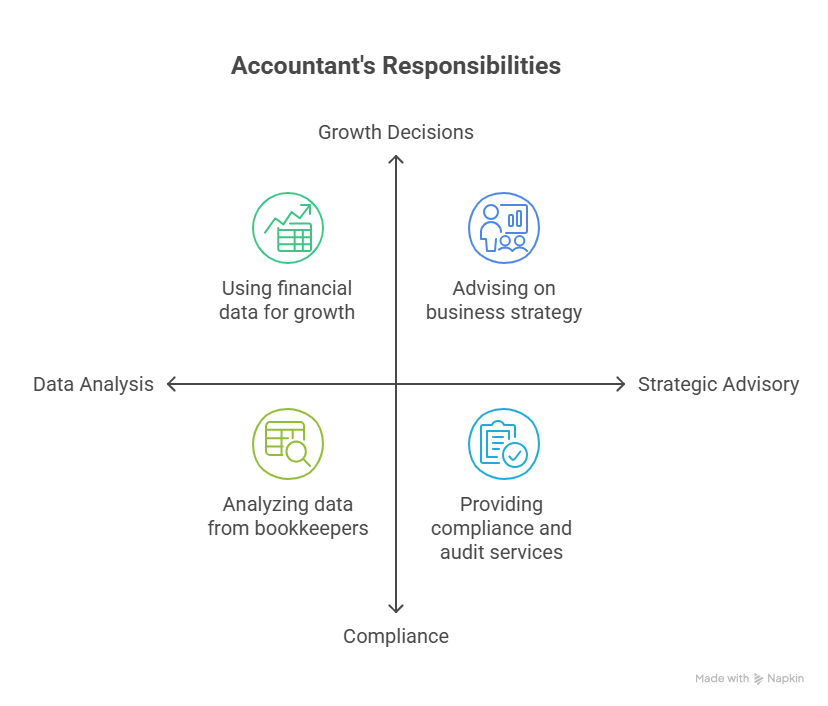
Accountants build on the bookkeeper’s work through responsibilities like the following:
- Analyzes and interprets data from bookkeepers.
- Provides compliance and audit services.
- Advises on business strategy and investment.
- Uses financial data to drive growth decisions.
Here’s how strategic financial management supports your next stage of growth.
Impact on Business Growth
Bookkeeper
Accurate financial records are the backbone of any growing business. A bookkeeper ensures that your day-to-day financial data is in order, which supports short-term decision-making. Their work helps maintain cash flow and manage operational costs. With their support, you can avoid costly mistakes and stay on track.
Bookkeepers drive operational stability through efforts like those described below:
- Supports daily cash flow tracking.
- Ensures clean and accurate records.
- Improves operational efficiency.
- Helps businesses stay audit-ready.
Accountant
Accountants contribute to business growth by offering big-picture analysis and strategic planning. They help you set budgets, identify trends, and allocate resources wisely. Accountants also provide valuable input during major financial decisions like investments or mergers. When bookkeepers and accountants work together, they create a powerful system for sustainable growth.
Accountants contribute to financial development in ways like the following:
- Develops long-term financial strategies.
- Analyzes profitability and trends.
- Supports funding and investment decisions.
- Guides financial planning for growth.
Whether you’re just starting or planning expansion, the right choice depends on where you are now.
Making the Right Choice for Your Business
Bookkeeper
Choosing the right professional depends on your business’s size, goals, and current financial situation. If you need help with day-to-day financial tasks, a bookkeeper is a practical and cost-effective solution. They help keep your operations running smoothly with accurate financial records. Their role is essential for building a reliable financial foundation.
You might prefer a bookkeeper if your business needs align with the points listed below:
- Ideal for small businesses and startups.
- Keeps financial records organized and updated.
- Helps manage recurring financial tasks.
- Prepares data for accountants and tax filing.
Accountant
If your focus is on strategic planning, compliance, and financial analysis, then hiring an accountant makes more sense. Their expertise is crucial for making informed business decisions and ensuring long-term success.
In many cases, employing both professionals offers the best of both worlds. At One Accounting, we provide both services to help you build a robust and scalable financial system.
An accountant makes the most sense when your needs align with the following:
- Offers strategic financial support.
- Ensures compliance with laws and standards.
- Helps businesses grow and scale effectively.
- Provides decision-making insights based on data.
Let’s close with a summary of how bookkeepers and accountants can support your goals.
Conclusion
At One Accounting, we tailor our financial services to meet your needs, combining trust, technology, and expertise to help your business thrive. Contact One Accounting today to schedule a consultation and discover how we can support your financial success.