How AI and Automation Are Changing Bookkeeping Journal Entries in 2025

Bookkeeping is no longer what it used to be. Gone are the days of long hours spent sorting receipts and manually entering every financial transaction. Businesses now demand speed, accuracy, and real-time insight to stay competitive. As a result, the bookkeeping profession is undergoing a massive transformation.
At One Accounting, we understand how these changes can feel overwhelming. That’s why we stay ahead of the curve with tools and technologies that help our clients thrive. Whether you’re a small business owner or a growing company, we ensure your bookkeeping processes are efficient and future-ready.
Let’s dive into how AI and automation are changing the game, especially when it comes to bookkeeping journal entries.
Understanding Bookkeeping Journal Entries
Before examining how AI is revolutionising things, it’s essential to understand what we’re changing. Bookkeeping journal entries are the foundation of every financial report, tax return, and cash flow analysis. Without them, it’s nearly impossible to keep track of what a business earns, spends, or owes. That’s why they’re a core part of any accounting system.
In a traditional setup, creating a journal entry involves manually inputting dates, amounts, descriptions, and account names. This requires attention to detail and plenty of time, especially when managing high transaction volumes. Most companies also rely on these entries to close books at the end of each month.
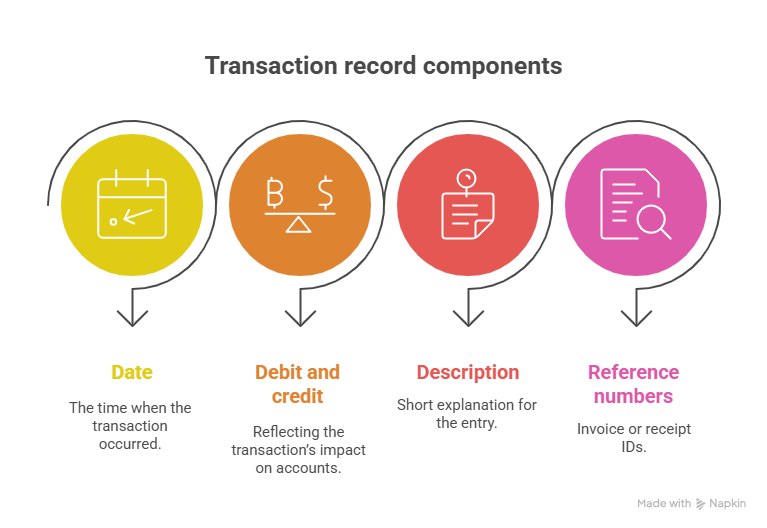
Bookkeepers rely on a consistent format when preparing journal entries, which includes the following:
- Date: When the transaction occurred
- Debit and credit amounts: Reflecting the transaction’s impact on accounts
- Description: Short explanation for the entry
- Reference numbers: Like invoice or receipt IDs
Traditionally, this was a manual process. Accountants had to input data, post it to ledgers, and make end-of-month adjustments. It was accurate, but also painfully slow.
With the basics in mind, it’s crucial to examine why traditional methods create friction and inefficiencies for today’s growing businesses.
Challenges of Manual Journal Entries
Manual bookkeeping may feel familiar, but it’s also filled with inefficiencies. For one, it’s easy to get distracted or fatigued, leading to critical mistakes. Even a small typo or misclassification can throw off an entire report. When this happens repeatedly, it creates serious problems during audits or financial reviews.
Moreover, manual processes don’t scale well. As your business grows, so do your transactions, doubling or tripling the workload. Hiring more staff helps, but it also increases payroll costs and slows down response times. This is where automation begins to show its value.
When relying solely on manual entries, businesses often encounter problems such as those outlined below:
- Time-draining entry work: Manual inputs required hours of attention.
- Risk of mistakes: Misclassified entries and typos were common.
- Audit delays: Missing data or unclear records made compliance tricky.
These issues didn’t just affect bookkeepers, they slowed down entire businesses.
With manual limitations clear, let’s explore how 2025’s technological advancements are streamlining the bookkeeping process like never before.
AI & Automation Trends in 2025
So, how are businesses keeping up in 2025? The answer lies in cutting-edge technologies like machine learning and generative AI. These tools don’t just speed up tasks, they fundamentally change how bookkeeping journal entries are created, reviewed, and applied. They’re not just smarter; they’re more consistent and adaptable.
From scanning documents to suggesting corrections, Artificial Intelligence now supports the entire bookkeeping workflow. That means fewer human errors, real-time processing, and better insights into your financial health. For businesses, this is a massive win. And for accountants, it’s a welcome shift toward more strategic work.
In 2025, several AI-powered trends are revolutionizing how journal entries are created and managed, as follows:
- Automated Data Entry & OCR: Tools now scan invoices, receipts, and bank statements and instantly convert them into entries.
- Machine Learning Categorization: AI systems learn how you classify your expenses and apply those rules going forward.
- Predictive Reconciliation: These tools now detect irregularities and reconcile accounts in real-time.
- Generative AI Agents: These smart agents go beyond basic AI, they interpret transactions, resolve exceptions, and complete entries with minimal input.
So, what does this look like in action? Here’s how AI is fundamentally changing the journal entry process from end to end.
How AI Impacts Journal Entry Processes
AI doesn’t just make processes faster, it makes them smarter. The moment you upload a document, the system knows what to do. It checks for balance, categorizes the data, and fills out a bookkeeping journal entry in seconds. For busy finance teams, this is a game-changer.
Accuracy is another big win. AI tools can spot anomalies that humans might miss, flagging them for review before they cause problems. This improves compliance and gives business owners peace of mind. Plus, these entries now update dashboards and reports in real-time.
When applied to financial workflows, AI offers significant advantages in speed, accuracy, and visibility, detailed below:
- Speed & Efficiency: You upload a document, and the system creates a clean, balanced bookkeeping journal entry almost instantly.
- Fewer Errors: Built-in checks help flag anything off-balance or unusual.
- Real-Time Dashboards: Journal entries now update dashboards in real-time, giving you better financial visibility.
This shift is helping both bookkeepers and business owners stay informed and in control.
Now that we’ve seen how the process is enhanced, let’s examine the real-world benefits AI brings to daily bookkeeping operations.
Benefits for Bookkeepers & Businesses
AI in bookkeeping isn’t about replacing people, it’s about elevating their role. When routine tasks are automated, bookkeepers can focus on planning, advising, and helping businesses grow. This makes their work more rewarding and their insights more valuable. It’s not just bookkeeping, it’s strategic support.
Businesses benefit, too. With AI tools managing entries, companies save time, reduce staffing costs, and gain financial clarity. They can handle more clients or transactions without sacrificing quality. It’s a win-win all around.
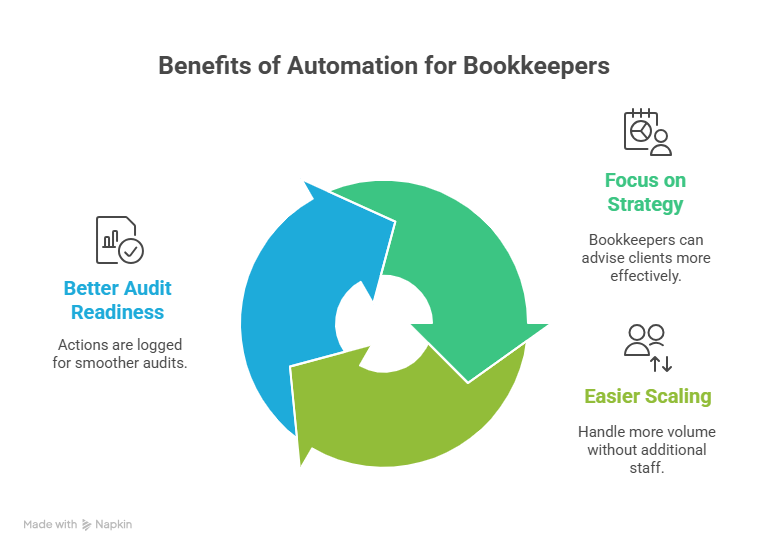
Automation doesn’t replace bookkeepers, it empowers them to deliver more value through benefits such as the following:
- More Focus on Strategy: Bookkeepers can now spend more time advising clients and less on typing.
- Easier Scaling: Automation makes it possible to handle more volume without needing more staff.
- Better Audit Readiness: Every action is logged, making reviews and audits smoother.
This means fewer headaches and better business decisions.
To make the most of these innovations, it’s essential to choose the right tools tailored to your business’s specific bookkeeping needs.
Top AI Tools & Platforms in 2025
With so many tools out there, it helps to know which ones stand out. The best platforms combine user-friendly design with powerful features. Whether you’re a solo entrepreneur or a growing business, these tools offer flexible solutions for managing bookkeeping journal entries. They’re easy to set up, simple to use, and packed with smart features.
Some focus on automation, while others emphasize reporting and forecasting. Depending on your needs, you can find a solution that matches your workflow and budget. Just remember, choose a tool that integrates well with your current system. That way, your entire process remains smooth and efficient.
Choosing the right software starts with understanding the most important evaluation criteria listed below:
- Docyt AI: Known for its high-level automation and beautiful custom dashboards.
- ERP.AI: Designed for auto-capture, it produces audit-ready journal entries with little manual input.
- AI Accountant Tools: These use intelligent OCR and categorization to streamline the bookkeeping process.
Key features to compare include the following:
- Data Capture Accuracy: How well the system reads documents
- Document Support: Can it handle PDFs, emails, and scanned images?
- Anomaly Detection: How well does it flag errors?
- System Integration: Does it work with QuickBooks, Xero, etc.?
- Pricing: Monthly cost and value-for-money
Before fully committing to an AI-driven process, it’s wise to consider the practical challenges and best practices that ensure success.
Challenges and Considerations
While the benefits are clear, there are still things to watch out for. AI is only as good as the data it’s given. If your receipts or records are messy, the results won’t be great. Clean, structured data is still the foundation of accurate bookkeeping journal entries.
And of course, any new system brings learning curves. From training staff to adjusting workflows, the transition takes time and effort. But with the right support and preparation, most businesses find it well worth it. At One Accounting, we help our clients plan for success.
Successful implementation depends on navigating issues like those described in the following:
- Garbage In, Garbage Out: If vendor or receipt data is messy, AI won’t fix it, it’ll just replicate the issue.
- Adoption Barriers: Training staff and integrating new software takes time.
- Data Privacy: Financial documents are sensitive. You need tools that follow strict data protection rules.
- Human Oversight Still Matters: AI helps, but a skilled accountant should still give the final sign-off.
It’s all about finding the right balance between automation and expert review.
If the past few years are any indication, the next wave of AI developments will bring even more transformative possibilities to accounting.
Future Outlook: The Next Evolution
Looking ahead, the future of bookkeeping is even more exciting. We’re starting to see concepts like triple-entry accounting, which adds a new layer of transparency. AI systems are also beginning to learn from multiple organizations while keeping their data secure. This could revolutionize how audits and financial reviews are handled.
And that’s just the beginning. Imagine a future where your bookkeeping journal entries are managed by intelligent agents that get smarter every month. These systems could handle complex transactions, flag risks, and offer advice all without constant input. The possibilities are enormous, and they’re already in motion.
These emerging innovations are set to elevate journal entry systems even further, highlighted below:
- Triple-Entry Accounting: Using machine learning to add a third layer of verification, boosting transparency.
- Federated Learning for Audits: AI models that detect fraud patterns across businesses while preserving privacy.
- Agentic Entry Systems: Fully autonomous agents that keep learning and handling entries independently.
That means more automation, more insights, and even better financial control.
With all these changes taking place, it’s important to have a partner who can help you navigate and benefit from this transformation.
Conclusion: How One Accounting Can Help
AI and automation are redefining how we manage bookkeeping journal entries with faster workflows, fewer errors, and greater insights. These innovations are no longer optional, they’re essential for any business that wants to grow with confidence.
At One Accounting, we help businesses like yours embrace these changes. Whether you’re new to AI tools or ready to upgrade your systems, our team of CPAs and tech-savvy professionals will guide you every step of the way. From setup to strategy, we ensure your bookkeeping journal entries are handled with accuracy and care.
Let’s future-proof your finances together.